A new septic system is a big part of any home build outside city sewer, and installing them is a core part of what Spring Creek Builds does. Whether you are building a new home in the country or putting a system in on a property that never had one, we handle the dirt work from the test holes through the install, and we work with the health district along the way.
Where a New Septic System Fits in a Home Build
On a new home outside city limits, the septic system is one of the first things to plan and one of the last things to go in. It has to be planned early because the property's soil and water table decide what kind of system the health district will approve. It goes in near the end of the project, once the plumber has the drain lines in place, so other contractors do not drive over it while the house is being built.
We do the excavation for the whole build, so we see how the septic fits with the foundation, the driveway, the well, and the utilities. That helps keep the system out of the way of everything else on the property.
How a New Septic Installation Works
Every install follows the same general path, and we explain each step so you know what comes next:
- Talk and site walk. We learn about the property and your plans, and we look at the site, often before the building location is final.
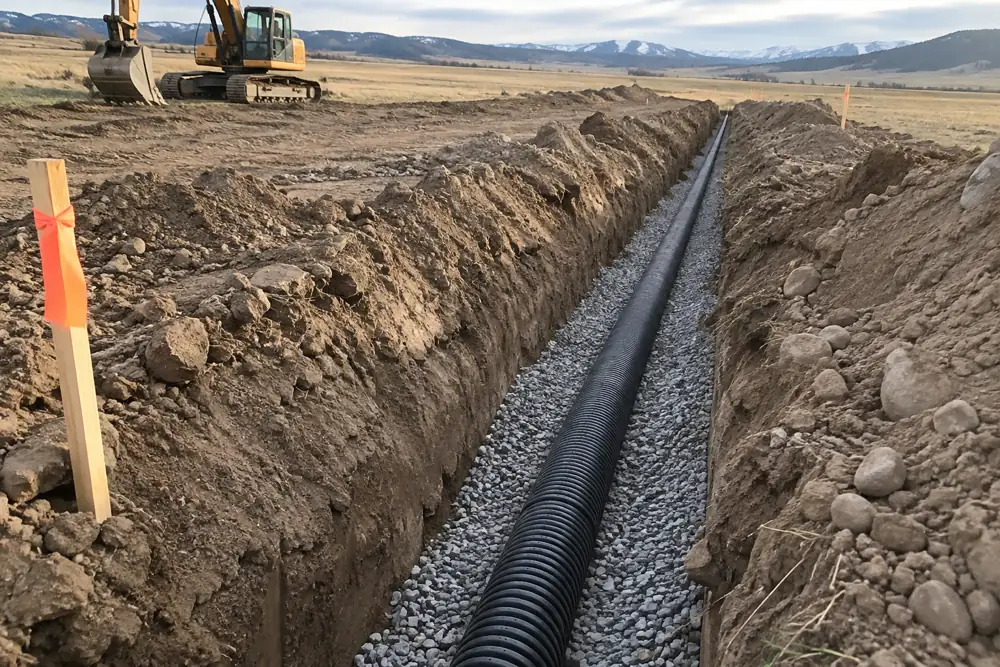
- Test holes. We dig test holes where the system could go. They show how the ground drains and how high the water sits, which is what the system design depends on.
- Health district evaluation. The local public health district comes out, looks at the test holes, and determines what kind of septic system the property needs. There are fees involved in that evaluation and in the permit, which are paid to the health district.
- Permit. The system has to be permitted before it goes in. If you are building with a general contractor, the GC usually handles the building permits. Homeowners building on their own usually handle theirs.
- Installation. Our crew installs the system to the approved plan, connecting the plumber's drain lines to the tank and running it out to the drain field.
Why We Start With Test Holes
Test holes are the step that tells you whether a property can actually handle the system you have in mind. We dig them for water elevation and ground conditions, and the health district's evaluation follows from what they show. If a property turns out to be a poor fit for a particular design, you find that out before you have built around the wrong plan.
Septic Work Done by the Same Crew That Digs the House
Most of our work is new-home excavation, so we are used to working alongside the concrete crew, the plumber, the well driller, and the other trades on a build. For homes that need both a foundation and a septic system, one excavation company can handle both. See our new construction excavation and utility trenching pages for the rest of the site work.
What to Have Ready When You Reach Out
- The property address or parcel location, and which county it is in
- Whether you already have a building permit, a septic permit, or a soil test
- Whether you are building a new home or adding a system to an existing property
- Your target timeline
If you are not sure where you stand, that is fine. Send us a message through the contact form and we will talk through the next step.
Where We Work
Spring Creek Builds provides septic system installation across the five eastern Idaho counties we serve. Find your area below, or see our full service area page.
- Teton County: Driggs, Victor, Tetonia
- Madison County: Rexburg, Sugar City
- Jefferson County: Rigby, Menan, Lewisville, Roberts
- Bonneville County: Idaho Falls, Ammon, Iona, Ucon
- Bingham County: Blackfoot, Shelley, Firth
Frequently Asked Questions
Yes. Test holes show the water elevation and ground conditions, and the local public health district evaluates them to decide what type of septic system the property needs.
The system must be permitted through the local health district before it is installed. If a general contractor is building your home, the GC usually handles building permits, and homeowners building on their own usually handle their own. We can talk you through the steps.
Usually near the end of the project. It goes in once the plumber has the drain lines ready, so other contractors do not drive over it during construction.
Then you may not need a septic system at all. On those properties we connect the home to the city sewer line instead.