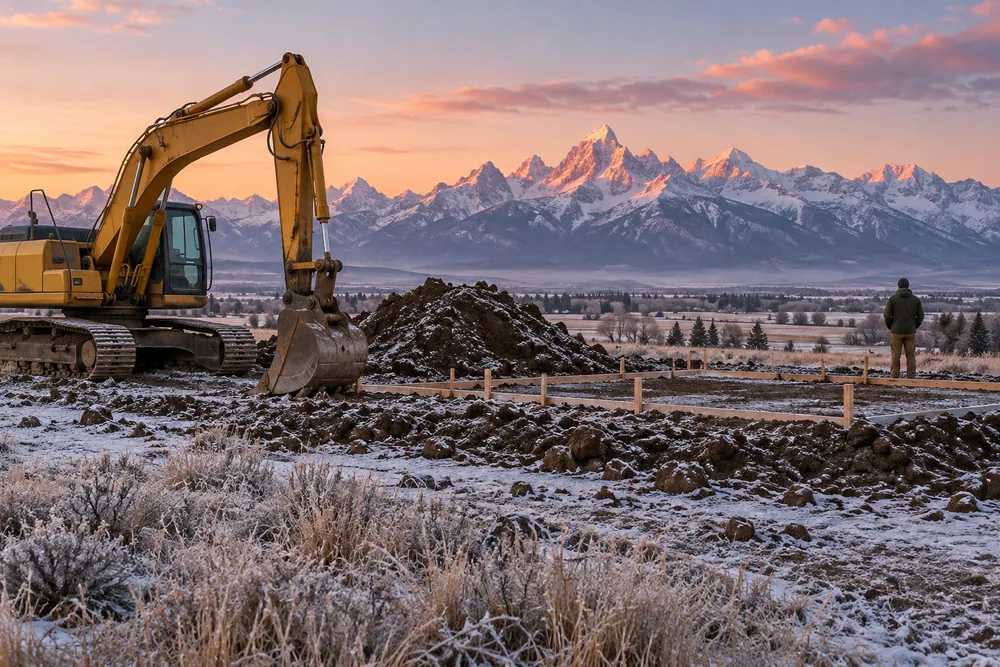
Anyone who has watched a November cold snap settle over the Teton Valley or the Snake River Plain knows the ground does not stay workable forever. Frost goes down, snow covers everything, and the question every owner and builder asks is the same: what can actually happen on the site before spring, and what has to wait?
The honest answer is that winter does not stop a project, but it changes the order of the work. This guide explains what frost depth really means for foundations in eastern Idaho, what frozen ground does to excavation and backfill, and how to use the cold months to get a spring start lined up.
What Winter Looks Like in Teton, Madison, Jefferson, Bonneville and Bingham Counties
Eastern Idaho sits high and cold. NOAA's 1991-2020 climate normals for the Driggs station, at about 6,120 feet, show a January average daily high of roughly 33 degrees and an average daily low of roughly 9 degrees. In a typical January that station sees the temperature stay at or below freezing all day on about 19 days, and drop to zero or lower on about 8 nights.
Snow follows the cold. A NOAA station southeast of Idaho Falls at about 5,800 feet averages roughly 16 inches of snowfall in December and 17 inches in January, and records at least an inch of snow on the ground on nearly 30 days in a typical January. Conditions vary a lot between the Teton Valley, the Rexburg and Rigby farmland, and the lower ground around Blackfoot and Shelley, so treat these figures as a starting point rather than a forecast for your lot.
Frost Depth: A Design Number, Not a Measurement
When a plan set says "frost depth," it means the minimum depth the local building department requires footings to reach so that frost cannot lift the foundation. It is a design figure adopted by each jurisdiction, and it is measured from finished grade to the bottom of the footing.
The published numbers we could confirm are close together. Teton County's design criteria list a 32-inch frost line. The City of Idaho Falls and Bingham County both list 30 inches. Madison, Jefferson and Bonneville County projects, and projects inside city limits, follow the numbers their own building departments publish, so ask the department that will issue your permit rather than assuming. Idaho currently uses the 2018 International Residential Code with state amendments, and that code does two things worth knowing:
- Foundation walls and piers must extend below the frost line, unless they are built as a frost-protected shallow foundation or another method the code allows.
- Footings may not bear on frozen soil unless the frozen condition is permanent.
That second point is why a footing excavation left open through a hard freeze is a problem, not a head start. Ground that freezes under a footing has to be thawed or removed before concrete goes in, so the builder and the concrete crew decide when a foundation pour makes sense, and the excavation is timed around that decision.
What Frozen Ground Does to Excavation and Backfill
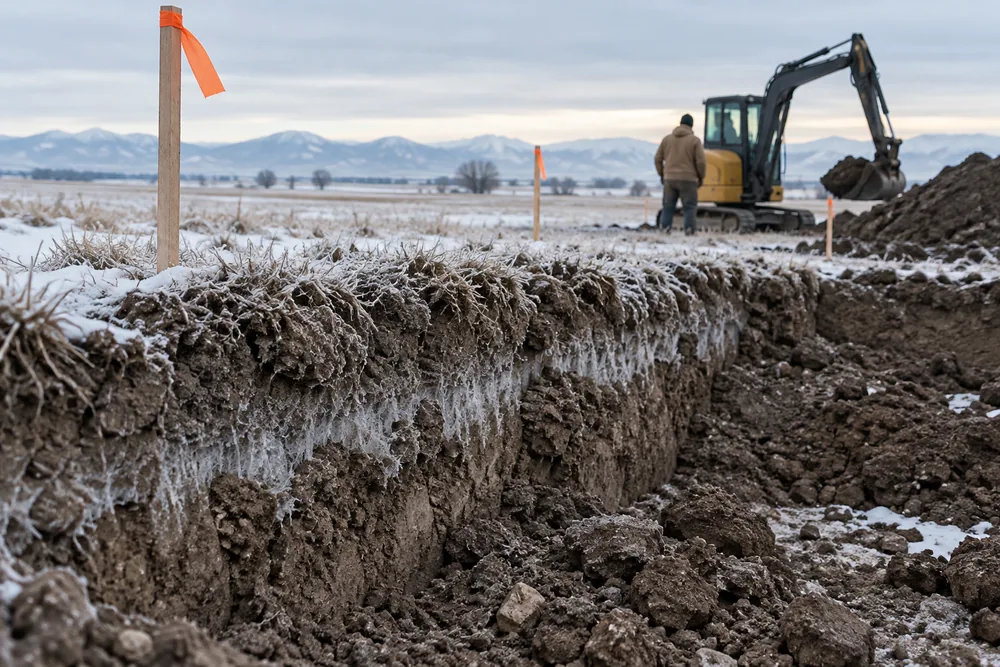
Frozen ground digs differently. The top layer breaks into hard slabs and clods, and it can hide the soil layers you need to see. Backfill is the bigger concern. Frozen clods do not compact, and when they thaw they leave voids that settle under slabs, steps, driveways and utility trenches.
That is why public works specifications are blunt about it. The Idaho Transportation Department's standard specification for structure backfill says not to use frozen material as backfill and not to place backfill on snow-covered or frozen surfaces, and to place it in thin, compacted lifts. Idaho's septic guidance says the same thing in its own terms: soil used to cover a drainfield must be free of debris, frozen clods, ice and snow. A home site is not a highway project, but the reasoning is identical.
Trench safety does not take a winter break either. Federal trenching rules require a protective system for excavations five feet deep or more, unless they are cut entirely in stable rock, and a competent person has to judge shallower ones. Ground conditions can also change quickly during thaw cycles, so the person in charge of the trench has to keep checking them.
Septic Work and the Winter Calendar
Septic systems have a calendar of their own. Test holes are dug so the health district can see the soil layers and the water level. Eastern Idaho Public Health describes a test hole dug to about ten feet, and Southeastern Idaho Public Health, which handles Bingham County, describes holes generally eight to ten feet deep depending on soil type. Idaho's septic guidance also notes that, where groundwater may be influenced by snowmelt, monitoring typically runs from February 15 through June 30, so on some sites the health district may ask for monitoring that runs into early summer.
Whether a particular lot can be evaluated in the dead of winter depends on the health district, the snow cover and the frost. Call before you plan around it. Either way, the paperwork side does not need to wait for thaw, and that is where most of the winter value is.
Five Things to Line Up Before Spring
- Get the septic application moving. Eastern Idaho Public Health says to plan on a minimum of two weeks to process an application, and the permit is valid for two years. We walk through the permit steps in a separate septic permit guide.
- Confirm your frost depth and drainage requirements with the building department that will issue your permit, and ask whether the foundation will be conventional or frost-protected.
- Have the survey and foundation layout ready so excavation can be laid out from the surveyed foundation points as soon as the ground allows.
- Plan utilities early. Power, water, fiber and sewer trenches all depend on utility requirements, and the Idaho one-call notice has a window: not less than two and not more than ten business days before digging.
- Settle access. Decide where the driveway will run and where snow will be stored, since a site that is hard to reach in March is hard to dig in March.
What to Expect Once the Ground Opens
In spring, the first weeks are usually about water. Thawing ground is soft, snowmelt runs across lots, and in the Teton Valley a rising water table can bring water to the surface in low areas. A U.S. Geological Survey study of the valley's groundwater notes that runoff usually peaks in the latter part of May or early June. A lot that looks dry in October can look very different then, which is another reason to walk it in winter with a plan in hand.
Frequently Asked Questions
How deep does the ground freeze in eastern Idaho?
It depends on the winter, the snow cover, the soil and the location. The numbers building departments publish, such as 32 inches in Teton County and 30 inches in Idaho Falls and Bingham County, are minimum footing depths for design. Actual frost can go deeper in a cold, low-snow winter, so do not use the design number to judge how hard the ground is.
Can a foundation be poured in winter?
That is a decision for the builder, the concrete contractor and the engineer or building department. Building code does not allow footings to bear on frozen soil, so the ground under a footing must be protected from freezing or thawed first.
Can a septic permit be applied for in the winter?
The application and plot plan can be prepared and submitted at any time of year. The site evaluation and test holes depend on conditions, so ask Eastern Idaho Public Health or Southeastern Idaho Public Health how they schedule winter evaluations for your county.
Should I wait until spring to call an excavator?
No. The permits, survey, utility requests and site access plan all take time, and calling early lets us talk through your lot, your timeline and what has to happen first.
If you are planning a new home, a septic system or site work in Teton, Madison, Jefferson, Bonneville or Bingham County, contact us through our contact page and tell us about the property. We will talk through what can be lined up this winter so the spring start goes smoothly.