If a new home will not be on city sewer, the first real decision on the property is where a septic system can go, and what kind. That question is answered by the ground, not by the floor plan, and it starts with test holes.
This guide explains what test holes are, why they come first, and who decides what kind of septic system a property needs in eastern Idaho. It is written for homeowners, builders, and developers working in Teton, Madison, Jefferson, Bonneville, and Bingham Counties.
What Test Holes Are
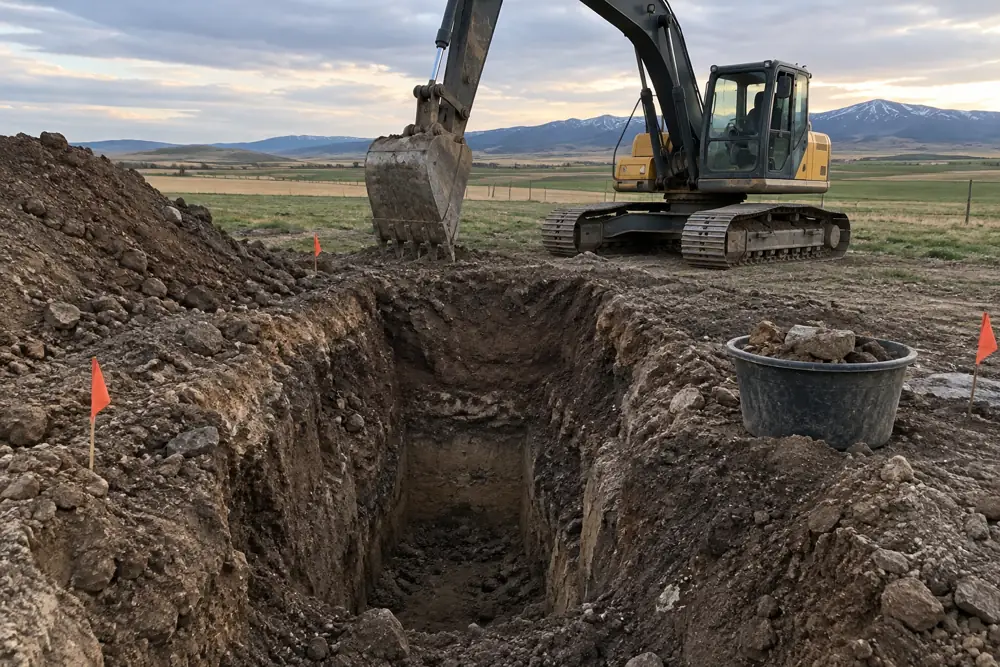
A test hole, sometimes called a test well, is an excavated pit dug where a septic system could be placed. It lets the people evaluating the site look at the soil layers and see how high the water is below the surface. That water elevation is one of the main things that decides what a system can look like on a given lot.
We dig test holes with our own equipment. The digging is the part we do. The evaluation of what we find belongs to the health district.
Who Decides What Kind of System You Need
In eastern Idaho, septic systems are evaluated and permitted through the local public health district, not by the excavator. Eastern Idaho Public Health serves Teton, Madison, Jefferson, and Bonneville Counties. Bingham County goes through Southeastern Idaho Public Health. After the test holes are dug, the health district comes out, looks at the site, and decides what kind of septic system is needed.
That is why the order of the work matters. We dig, they evaluate, and the type of system comes from their findings. We then install the system that the permit calls for.
Why Test Holes Come Before the Rest of the Build
On a lot that will use a septic system, the result of the evaluation shapes the project. It can affect where the house sits, how the yard is laid out, and what the total site work looks like. It makes sense to learn that before the foundation is staked out, not after.
The timing is also practical. Test holes happen right after you decide to go forward with a property. After that, the homeowner or the general contractor starts the building permit process, and the survey and foundation excavation follow. If the septic answer comes late, it can hold everything else up.
If Your Lot Is on City Sewer
Not every new home needs a septic system. Homes inside city limits are often able to connect to the city sewer. When that is the case, we connect the new home to the city line instead of installing a septic system, and the test hole and evaluation step does not apply in the same way. If you are not sure which applies to your lot, ask before you plan the build around it.
Before You Buy a Lot
If you are still deciding on a property, a walkthrough with an excavator before you commit can save a lot of trouble. A lot that looks perfect can have water close to the surface or other problems that change what is possible. We would rather talk through that with you before you buy than after.
What to Have Ready
- The address or parcel location, and whether the lot is inside city limits. Many homes inside city limits connect to city sewer instead of a septic system.
- Whether you or your builder have started on the building permit.
- Anything you already have: a prior test, a survey, a plan, or a permit.
- A rough idea of where you would like the house, so we can think about access for equipment.
Where This Fits in the Whole Project
Test holes are step one of a longer sequence. After the permits, survey, and foundation work, the septic system itself usually goes in near the end of the build, after the plumber has the drain lines in place, so other trades do not drive over it. We walk through the whole order in our guide to the order of work on a new home.
Ready to talk through a lot? Send us a message, and see our septic system installation page for how that work fits in.