If you have never built a home before, the dirt work can look like a blur: a machine shows up, a hole appears, and a few months later there is a house. Behind that is a sequence, and the order matters. Doing a step too early or too late is how projects get delayed or reworked.
This is the order we follow on a new home in eastern Idaho, from the first walk of the property to the point where we hand the site back to the builder. Every lot is different, but the sequence is a good map for homeowners, general contractors, and developers in Teton, Madison, Jefferson, Bonneville, and Bingham Counties.
1. A Walkthrough Before Anything Else
We start with a pre-site walkthrough. Before any machine is moved, we want to see the ground, the access, and where the home and the septic system could go. If you are still deciding whether to buy a property, this is the best time to have someone look at it with you.
2. Test Holes for the Septic System
If you decide to buy and move forward, the next step is digging test holes on the property. On a lot that will not connect to a city sewer, test holes show what is underground, including the water elevation. The health district then evaluates the site and determines what kind of septic system the property needs. You can read more in our guide to septic test holes and the health district.
3. The Building Permit and the Design
The homeowner, or the general contractor if one is involved, gets the building permit. The design has to be signed off by the city or county where the home is being built. This step is on the owner or builder, not on the excavator, but it sets the schedule for everything after it. Permits can take a few weeks, so it pays to start early.
4. Survey and Foundation Excavation
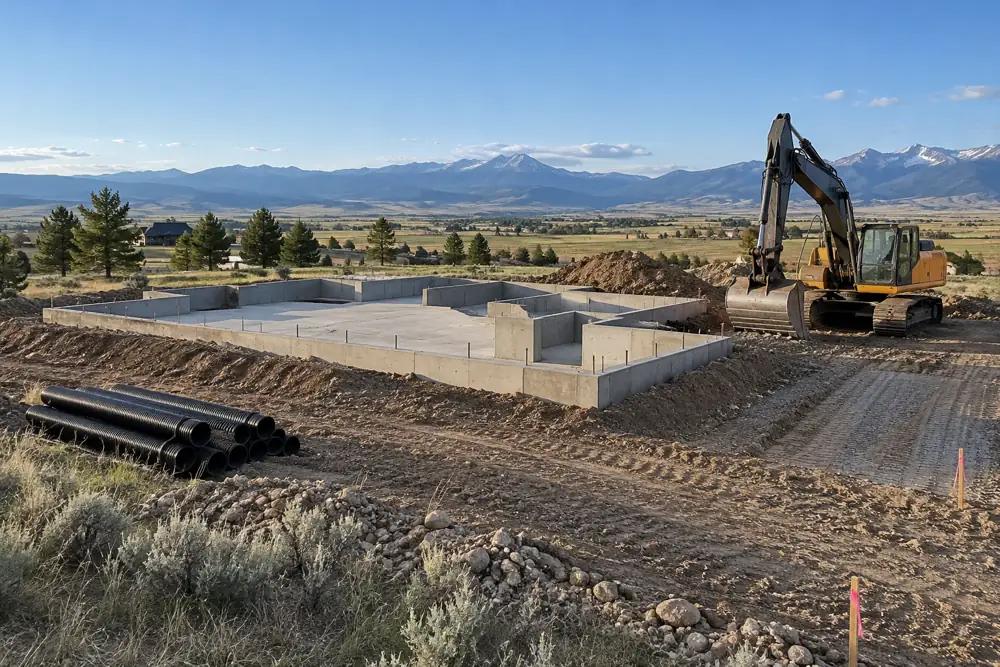
Once the permits are in place, the property is surveyed so the foundation corners are marked exactly, from foundation point to foundation point. Then we excavate the foundation. Some builders also request a geotechnical or compaction check to confirm the ground is ready for the foundation, and we work that into the schedule when it is asked for.
5. The Concrete Crew, Then Underground Utilities
After the excavation is ready, the concrete company forms and pours the foundation. Once that is done, we put in the underground utilities that run inside the foundation and then backfill around it. Doing these in order keeps lines where the plumber and the builder expect them.
6. Driveway and Site Prep
If the owner wants a driveway, we build it as dirt work and prep it for the concrete or asphalt crew. We do not pour concrete or lay asphalt. We prepare the base. We can also prep areas for patios and parking, and leave the grade ready for a landscaping crew. See our page on grading and driveways.
7. Power, Water, and Sewer or Septic
While the house goes up, we bring in power so the trades have electricity on site. We coordinate with the well driller, or connect to city water, depending on the lot. Where the home is on city sewer, we connect to it. Where it is not, the septic system goes in later in the build, once the plumber is ready, so other contractors do not drive over it.
When the plumber has the drain lines in place, we connect the tank to the house and run the line out to the drain field. Then the work is inspected before we backfill, which is what allows the home to be cleared for occupancy.
What Homeowners Can Do to Keep It Moving
- Start the permit early. It is the step the owner or builder controls, and it can take a few weeks.
- Decide on the driveway and patio early. If you want prep for a driveway, patio, or parking area, tell us before the foundation work so the grades work out.
- Keep in touch. Plans change during a build. We would rather hear about a change in a quick call or text than find out when the machine is already on site.
- Give us access. Equipment needs a way in, so think about where trucks and machines can get to the lot.
Why the Order Matters
Most delays on a new build come from steps arriving out of order: a permit that was started late, utilities that were not marked, or a tank that was placed before the rest of the site was done. Knowing the sequence lets you plan around it, and lets you ask the right questions of your builder.
If you are planning a new home in eastern Idaho and want to talk through where your lot is in this sequence, send us a message. You can also see our new construction excavation and foundation site prep pages.